Model Context Protocol (MCP): The Backbone of Next-Gen AI Applications
Building advanced AI applications is messy, indeed. Developers juggle fragmented model context, struggle to scale, and face inconsistent standards. Without a unified approach, even powerful AI models hit bottlenecks.
That’s where the Model Context Protocol, or MCP, comes in. MCP powers next-gen AI applications by organizing context, enabling scalable AI systems, and streamlining development workflows.
In this article, let’s talk about how MCP powers next-gen AI applications, break down how MCP works, explore the benefits of Model Context Protocol for developers, and show why understanding it is essential for anyone shaping the future of artificial intelligence.
What is Model Context Protocol (MCP)?
MCP, or Model Context Protocol, is a framework that organizes and shares the “state” of AI models. It solves a common problem while granting consistency in the way to manage context, especially since AI applications can act inconsistently, waste resources, or fail to scale effectively.
MCP ensures every model knows what’s happening, when, and how, so developers can focus on building smarter AI instead of firefighting context issues.
Source: AWS Amazon
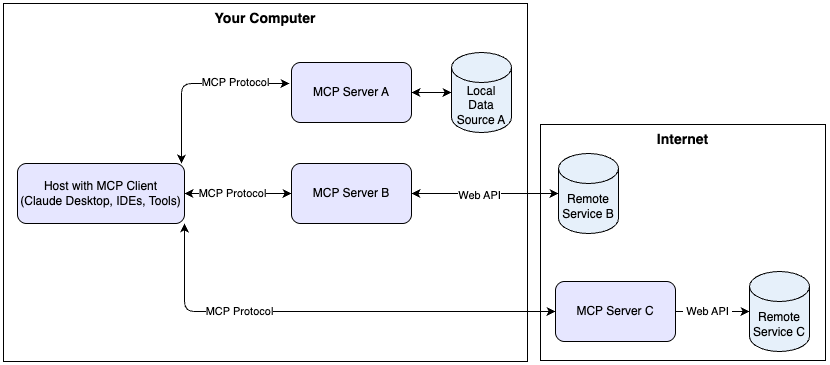
MCP works by standardizing how context is stored, shared, and updated across AI systems. And the core components of MCP include context storage, context sharing, and state management.
One thing that I have noticed about MCP’s client server architecture is the unique merger of AI applications, MCP servers, and the standardized data sources. The communication between the server and application flows between the clients and servers creating a framework. Through this framework, multiple models and modules interact smoothly and as a result, it helps an AI application development company workflows more efficient.
MCP relies on defined protocols to ensure interoperability across AI platforms. These standards let AI systems communicate without friction, reducing errors and supporting MCP for scalable AI systems.
Why is MCP Critical for Next-Gen AI Applications?
Traditional AI setups struggle with fragmented workflows, slow adaptation to changing data, and inefficient context handling. These issues block developers from creating AI-driven software development that’s reliable and scalable. Here’s how MCP for scalable AI systems helps;
- Centralized Context Management: MCP keeps all model states organized in one place, reducing errors and inconsistencies.
- Faster Model Interaction: Standardized protocols let models communicate and share context in real time.
- Simplified Scaling: Developers can add new AI modules or expand systems without breaking workflows.
- Consistent Performance: By managing context efficiently, MCP ensures predictable and reliable AI behavior across applications.
- Support for Complex AI Systems: MCP enables multi-modal AI & real-time AI interactions that traditional setups struggle to handle.
- Streamlined Development: The MCP framework reduces redundant work, letting AI application development companies focus on innovation instead of troubleshooting.
MCP centralizes context management, enabling faster model interaction and simpler scaling. Standardizing how AI models communicate reduces errors, accelerates development, and ensures consistency across applications.
One of the benefits of Model Context Protocol for developers is that they can build multi-modal AI, real-time AI interactions, and AI-as-a-service platforms. Essentially, it empowers the next-gen AI applications while laying the foundation for the future of artificial intelligence.
What are the Practical Applications of MCP?
MCP is not a simple technical framework; it’s the engine that lets AI systems work smarter, faster, and more reliably. By standardizing context management, MCP enables applications that traditional AI setups struggle to handle.
- Multiple Context Management: AI assistance built with MCP can handle multiple conversations and threads ensuring coherent and context-aware responses, every time.
- Personalizations and Recommandations: With MCP, you can build recommendation engines to deliver context-relevant suggestions in real time.
- Autonomous Systems: The MCP system further supports real-time state management to supervise pre-built and existing systems enabling adaptive decision-making.
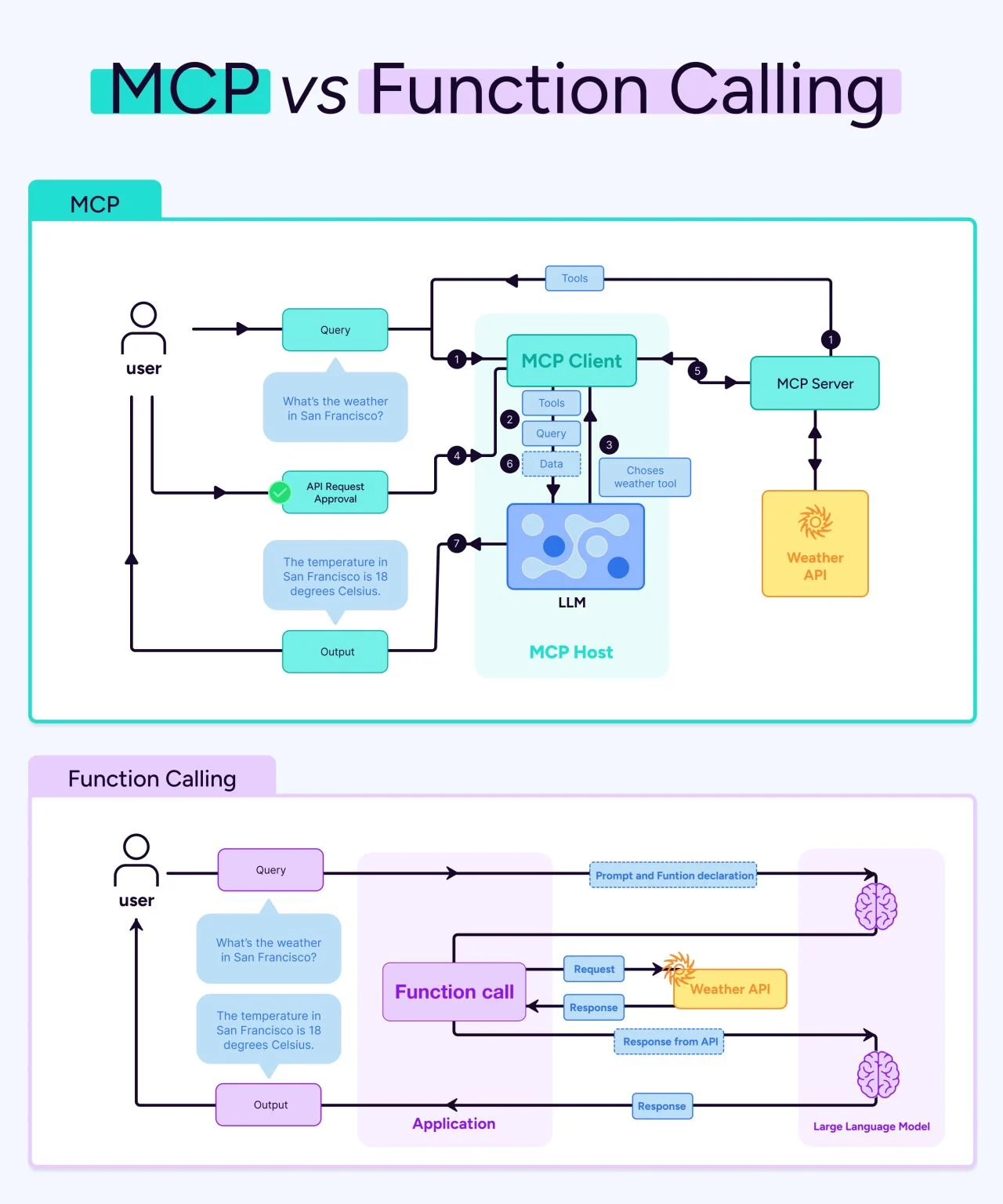
Here’s an example of a workflow diagram supervised by an MCP enabled system. The image below shows how context flows between models, highlighting how MCP powers next-gen AI applications and supports scalable AI systems.
Source: Codingscape
Model Context Protocol and Other Software Development Approaches
While we are working to build the future of AI with the MCP protocol in software development, traditional methods often struggle to keep up with the demands of modern AI. MCP provides a structured, scalable approach that unlocks real performance benefits.
Where Does MCP Stand Out for an AI Application Development Company?
One of the long standing issues with AI application development companies is when they try to build complex systems, even the tiniest of inefficiency can swell to become a large barrier in progress.
Model Context Protocol can tackle this challenge by creating a framework as we build at Mobmaxime to keep the AI models aligned and scalable. This also ensures our models are ready for real-time operations.
- Standardization: MCP builds a unified workflow protocol that all models built within the MCP interpret accurately and consistently.
- Scalability: New models and systems are added within the same workflow without breaking the existing ones.
- Interoperability: With the MCP enabling seamless communications, it ensures interaction and interoperability across different systems and AI platforms.
- Real-Time Efficiency: The updates you share with regards to the MCP application development reflect immediately while supporting multi-modal workflows.
- User Experience Consistency: We have observed that when applications maintain coherent behavior through MCP, development becomes easier across all sessions and devices.
- AI Advanced Systems: With MCP, building AI-driven software development solutions and prediction engines is easier, more practical, and the results are more reliable.
- Deployment is Faster: Since everything is streamlined in the MCP system, project delivery is accelerated and timelines are achievable.
| Feature / Approach | Traditional Methods | MCP Protocol |
| Context Consistency | Low/inconsistent | High/standardized |
| Scalability | Limited | Easily scalable |
| Interoperability | Poor | Seamless across platforms |
| Real-Time Updates | Slow/fragmented | Instant and reliable |
| Suitable for Multi-Modal AI | Challenging | Fully supported |
Benefits of Model Context Protocol (MCP) for AI Application Development Company
The Model Context Protocol offers practical advantages for anyone building or managing AI systems. All the benefits are a result of redefined context and its implementation. Through this, the MCP delivers measurable gains across performance, reliability, and user experience.
-
Better Performance and Reliability
All developers will confirm that traditional AI models often run into issues when the context in AI application development shifts. Things like changes in conversations or new data updates often mess up the systems.
But the MCP system fixes this issue by keeping all models synchronized with accurate and current information. As a result, there are fewer errors, smoother interactions and outcomes are naturally more reliable.
-
Ease of Integration
In a single AI-driven application or software, we have to add different interconnected AI systems leading to webbed workarounds. At times we also have to add custom integrations.
MCP eliminates this mess by creating a standardized format for AI models to exchange context and hence developers can then plug in new components without having to rebuild the entire system.
-
Multi System Orchestration
MCP builds different AI components and databases that must work together. Similar to the point we discussed on interoperability, the MCP system automates complex workflows even if they span into multiple systems.
MCP intelligently allocates resources while handling failures as they occur. In addition to these, it also creates ecosystems where different models combine together to tackle tasks that prove to be too complex for any single model.
-
Better User Experiences in AI Applications
Consistency is the core benefit of predictive analytics and AI systems used by the MCP to deliver smoother and more consistent results. Since the context is aligned and standardized across all models, the user experiences are streamlined, coherent, and also personalized even if they are delivered across longer interactions and multi-device environments.
-
Reduced Hallucinations
In AI models, hallucinations occur when you use untrained AI models that can fill in the missing context with made-up and incorrect assumptions. With MCP, this is minimized as it ensures every AI model has access to accurate and shared data at all times.
-
Better Utility of AI and Automation
AI can automate complex tasks without human oversight, but MCP provides that foundation allowing AI systems to collaborate, make independent decisions, and perform adaptive actions across workflows.
-
Enterprise-Ready Scalability
For large organizations, scaling AI systems often means balancing performance with reliability. MCP’s unified structure supports both. It allows enterprises to expand their AI ecosystem without fragmenting context or overcomplicating infrastructure.
MCP is both technically and strategically beneficial for AI software development company as it future proof’s your clients AI capabilities and ensures the models integrated are interoperable and scalable.
Future of AI with MCP Protocol and Building Scalable AI Systems
Model Context Protocol is setting the stage for what’s to come. With increasingly collaborative, connected, and autonomous AI systems, the power to share context effortlessly will determine the platforms that will lead and those that will lag behind.
MCP offers that connecting framework, paving the way for the next iteration of intelligent software development.
- Cross-Platform AI Systems: MCP allows varying AI models, applications, and platforms to communicate without interruptions and with each other easily. Cross-platform compatibility will prove invaluable as businesses move toward integrated AI ecosystems.
- Collaborative AI: As several models start working together aligning everything from vision to language to predictive systems, MCP enables them to work with an understanding of context, allowing genuine collaboration.
- Emerging AI-as-a-Service Architectures: MCP improves AI-as-a-Service by simplifying the ability for developers and AI application development companies to create modular, scalable services that integrate into current environments without extensive integration effort.
- Dynamic Context Learning: Future-oriented MCP-powered systems learn from new and existing data continuously, refreshing shared context in real-time to enhance precision and decision-making.
- Predictive Context Adaptation: We know that AI has predictive capabilities and can anticipate the user’s needs plus environment changes. Based on this, MCP-built AI applications benefit from proactive context refreshes across web-connected systems.
- Multi-Agent Coordination: As distributed AI increases, MCP will enable distributed networks of expert agents that collaborate seamlessly, handling intricate workflows, decision-making automation, and scaling insight across domains.
The future of artificial intelligence will not be based on strong models alone; it will be based on how effectively those models comprehend, exchange, and respond to context. MCP for scalable AI systems is that paradigm from discrete intelligence to cohesive cognition. For developers and businesses alike, accepting the future of AI with the MCP protocol is about getting ready for a world in which AI does not merely respond but cooperates, anticipates, and adapts.
Conclusion
Speaking from experience, I think that Model Context Protocol will become the core backbone of next-gen AI applications, software, and systems. We are already building intelligent, adaptive, and interoperable systems with artificial intelligence, but MCP takes it up by one notch ahead by unifying how models manage and share context.
So we can now progress from isolated AI workflows to fully integrated intelligence ecosystems. At Mobmaxime we help organizations harness the power of cutting-edge technologies like MCP to build scalable, context-aware AI applications that deliver real business impact. So from modernizing your core AI infrastructure to exploring the potential of interoperable systems, our experts help design, integrate, and optimize everything with precision.
FAQs
- How does MCP work in AI?
Model Context Protocol (MCP) works on the existing concepts including tool use and function calling, but it also standardizes them. This standardization reduces the need for custom connections for every new AI model and external systems. As a result, LLMs and AI models use current and real world data to update their systems, perform actions, and access new features.
- What is MCP, and how does it integrate with Figma or design tooling?
Model Context Protocol (MCP) standardizes the method and communication of how AI models access and share data across different systems and applications. In Figma, MCP connects the design environment with external and internal AI tools. This leads to real-time updates, token synchronization, and design-to-code automation.
- How does an MCP server connect AI models to external data sources?
An MCP server is a sort of interpreter or middleman linking AI models with structured data sources. This includes APIs, databases, and design systems and more. Not only does the MCP connect, it also manages authentication, context development, and data flow, while allowing AI models to extract the required information and create better applications.
- Can I use MCP together with Figma to build context-aware design assistants?
It is possible to build such design assistants when you integrate MCP into Figma. These assistants will understand the layout format, component libraries, and user actions while suggesting improvements in the design. If trained with authentic AI models, they can also auto-generate the code and maintain design consistency across all projects, of course, after some training and configurations.
- Is MCP secure? What are its vulnerabilities, and how can I mitigate them?
Yes, MCP is secure as it uses secure API protocols, authentication layers, and context isolation to protect data. There are risks involved typically arising from misconfigured access controls and unencrypted endpoints. To prevent these risks from realizing, use HTTPS and token based authentication.
- How many AI models can an MCP server support concurrently?
We have not come across any limit as of now on the number of AI models that can connect with the MCP system. Everything depends on the server configuration and compute resources you have at present. The MCP servers are designed to handle concurrent models, but their supporting infrastructure and containerized deployment systems matter.