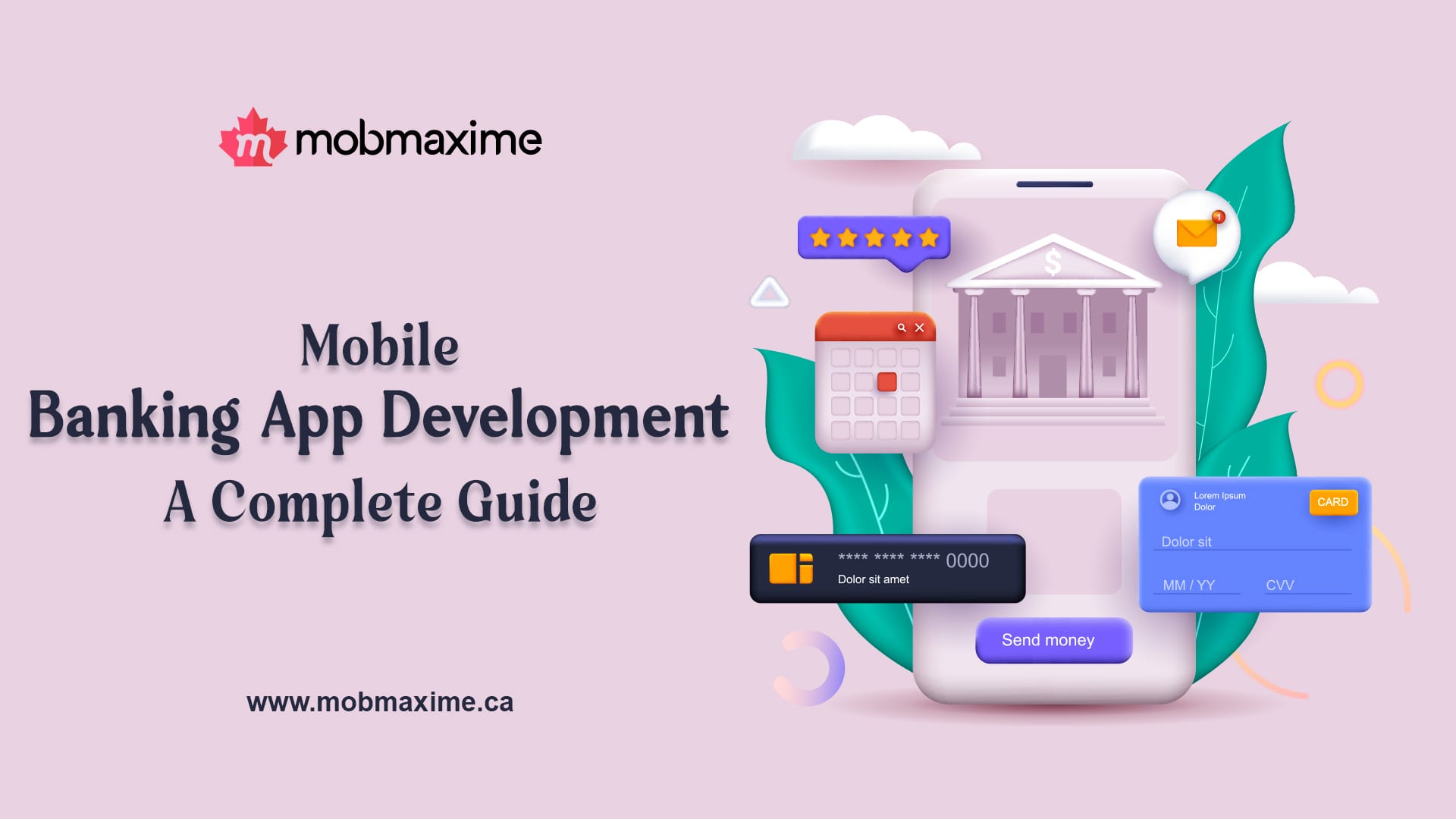
Mobile Banking App Development: A Complete Guide
- 9 Minutes. to Read
- 194 Views
- 39
More than 1.9 billion people are using mobile banking applications today. Considering the fact that the first internet banking services were launched by American Bank Wells Fargo in 1995. In these many years, the trend of mobile banking applications has increased enormously.
Moreover, as per Statista, the number of people utilizing a bank’s application for their daily transactions will increase to more than 2.5 billion by 2024. The fact that we can conduct transactions of millions without ever stepping into a bank, and that too without any security risks, is amazing.
Since finance is a highly confidential and personal thing for a person, the bank application we interact with on the mobile must have the best form of security and a seamless interface. In this article, we will identify the process behind the best banking app development.
Understanding Mobile Banking and its Benefits
If you are a bank wanting to build your bank’s application or a developer looking for some answers, understanding mobile banking is the first step of the process. In simple terms, mobile banking allows users to conduct financial transactions any location with internet access using a smartphone or a tablet. Most of the mobile applications allow users to perform the same functions from the palm of their hands without ever stepping into the bank.
So, if you want to transfer money into another account or apply for a new chequebook, start a Fixed Deposit, etc. All these processes can be completed from a mobile phone. Hence, a mobile bank application makes things easier for customers.
Some of the benefits associated with using a mobile application includes the following;
- 24/7 access to the bank’s services.
- Easy, secure, and quick money transfer.
- Check account balance and other details easily.
- Get instant notifications for all types of transactions.
- Intuitive user interface and design.
- Tracking spending and purchases.
To sum it up, a mobile banking application provides several time and cost-saving functions. Moreover, some banks have two different iterations of their application, one for the customers and another for businesses. The features and functions of both these types of applications are the same, but the difference lies in the transaction limits.
With this understood, let’s move on to tracing the mobile banking app development steps and procedure.
Development of a Mobile Banking Application
Mobile application development is a 7-step process allowing developers or development companies to create the most efficient solution. Every step is equally important for the development process.
-
Research and Analysis
Research and analysis is the first step in any form of the development process. Be it that you are building a bank application, a game, or a social media, application research is essential.
Research take different forms here
- The business analysts research the market trends and the existing cohort of customers. They will create user persona profiles to identify their ideal habits and pain points from using a mobile bank application.
Creating a user’s persona will allow the analysts to identify the features and functions that will make your solution better than others available in the market. Also, it is important to check the market habits.
- Another research activity will include analyzing the current market. In this, the analysts identify how the market is behaving vis-a-vis bank applications.
- The third type of research must include analyzing the existing applications and their position in relation to customer requirements. For instance, today, a major chunk of the population has credit cards. So, should a bank include credit card features in their bank application or create a separate application for credit cards.
At the end of these rounds, the developers and analysts will understand the target audience, their competition, features of popular banking applications, the ideal UI design elements, and the user’s expectations.
-
Identifying the Security Requirements
Anyone using a mobile bank application has to race through several vulnerabilities and risks. This includes data vulnerability, malware, unsecured Wi-Fi networks and data networks, etc. As a result, the end user’s financial information is at risk.
As a banking services provider, the onus of ensuring rigorous security is on you, and we can become the executors. Working as the best mobile app development company, we understand these requirements and always recommend the required security features for our clients.
- Password Security: In a mobile bank application, it is important to store all passwords in a hash function before they are stored in the database. Applying the hash function secures the password and prevents any third-party entity from accessing it without authorization.
- Auto-Logout: Another good security feature to be included in a mobile bank application is auto-logout. This will ensure that no user stays logged in after using the application. Automatic logout prevents any unauthorized person from accessing financial information.
- Security Certificates: Although obtaining the security certificate comes later, let’s talk about it here only. Security certificates protect and authenticate the application code and ensure that it is not tampered with in any instance. Moreover, these security certificates also act as a confidence and trust-enhancing attribute.
- Authentication: Make sure to add the fingerprint security feature in the application. This means that the users will be able to access their account and profile by authenticating their account using a fingerprint.
-
Application Designing and UI/UX Strategizing
An application’s design is the next most important aspect of the development process. It’s an integral part of mobile banking app development and allows users to have a good customer experience. Your customers want to use an application that is simple and convenient. It needs to have a clear set of navigation and scrollability. Plus, it must have an intuitive interface filled with necessary buttons, icons, color palettes, and imagery that blends in with the overall design.
We have seen a lot of bank applications that have great functionality but lack in terms of design. As a result, there is a gap in the market for well-designed applications. The outdated application designs lead to a loss of customer experience.
The lack of good design increases the frustration of the end-user, and they might feel demotivated to use the application. As a result, the users are substituting other instant pay applications and wallets with a bank’s application.
A good application design exercise begins with understanding the issues end-users are facing while using a bank’s mobile application. As these applications deal with sensitive financial information, the application must be designed to make the user’s engagement easier and not complex.
Working as the best mobile banking app development company, we build the prototype before moving to the development stage. The clickable prototype we create enables us to check the application’s performance and interface. We can identify the mistakes and also correct them before codifying them into a working application.
UI and UX Strategizing
Another element of designing the bank application is UI and UX strategy. The UI/UX strategy includes identifying the design elements to improve the overall customer experience. A simple thing as the placement of the Pay button, can make a difference in the user experience.
That’s why we dive deep into UI/UX research to identify such elements and create a customer-friendly design. While doing so, we also ensure that the design is simple and intuitive.
Our approach ensures that the application’s design and color scheme correspond to the corporate brand’s identity. We also ensure that the app navigation takes into account the architecture of the solution. Plus we also consider the cultural differences while working on the design.
-
Application Development and Coding
The next and one of the longest steps in mobile banking app development is writing the code. In this stage, we write the code for your application from scratch or use the pre-written code scripts and modify them to take shape and structure of the application you want.
Our dedicated developers work with the best coding practices to produce reliable, scalable, and testable code. One of the most important decisions here is whether to build a native application or go ahead with a cross-platform application.
Understand that from a security perspective; a native application is better than a cross-platform application. Cross-platform means when we write the code once, but the application runs on every platform easily.
This means that the same code will be compiled and rendered for Android, iOS, and Windows-based devices. But when you go ahead with native applications, we will write them separately for iOS, Windows, and Android.
As a result, the technologies used for the development exercises also differ. For iOS, we can use technologies like Swift, XCode, and iOS SDK. But for Android, we will use Java/Kotlin, Android Studio, and related technologies.
The initial focus should be to build the MVP or Most Viable Product. This is the product iteration that has the basic features and a good design. The purpose of building an MVP is to check the performance and user response and spend less money on testing the waters. This approach saves a lot of time, disappointment, and costs.
So, we won’t include advanced features like AR, VR, gamification, etc., in the MVP version. However, once the application gains some traction and gets a good user response, more features and systems can be added, including chatbots, voice control features, etc.
-
Testing the Application
After coding is complete, the next step is testing the application. This is where we conduct different types of tests on the application, including performance, security, unit, functional, and integration. Some of these are automated, where we use advanced systems like Jenkins to write the test script and find any sort of issues with the application.
After fixing the issues, we also work to find any sort of bugs in the code before deployment. This is a relatively smaller part of the development process but is equally important as others. Every mobile app development company has a team of testing and quality assurance professionals working to find the issues and ensure seamless performance.
-
Launch and Deployment
The next part is where you launch the application on the designated application stores. For Android, it’s the Play Store, and for iOS, it’s the App Store. However, both these platforms have a set of requirements and conditions that an application must fulfill for a successful listing.
Don’t worry; we will help you complete all of these requirements and conditions. Moreover, our launch sequence is handled by subject-matter experts as they understand the nuances of a good launch.
-
Continuous Monitoring and Feedback
After the launch, it is essential to keep an eye on the application’s performance and user feedback. You need to keep an eye on how the customers are taking the application. Are they facing any issues in the UI/UX design of the application, or is the code suitable for a high load of users and transactions, etc.?
It is essential to correct the performance and other issues as they arise to continue giving the users a good customer experience. As one of the best mobile app development company, we can help you with the continuous monitoring part and provide effective resolutions for all issues.
The mobile banking app development process involves going through different steps and processes. To build the best iteration of an application, it is essential to hire the best mobile app development company. The choice of the right company will help you provide a great solution to your customers and gain their trust and confidence.
Conclusion
Every mobile application development process is different. This is because the purpose, tech stack, industry, etc., associated with the application is also different. As a result, how the application turns out depends on your requirements. However, the structure of the process to build a mobile application is common for all.
As a mobile banking app development company, we understand your requirements, followed by creating the design, writing the code, and deploying the application. At Mobmaxime, you will find access to an intelligent team of designers and developers working together to other technology and process experts for building the most amazing application.
Table of Contents
Recent Blog
-

Cursor AI vs Google Antigravity: Which AI Coding Tool Wins?
March 14, 2023 -

-

Agentic AI Coding Tools Every Developer Should Know
March 14, 2023 -

How Agentic AI Is Reshaping Software Development
March 14, 2023
Category
Newsletter