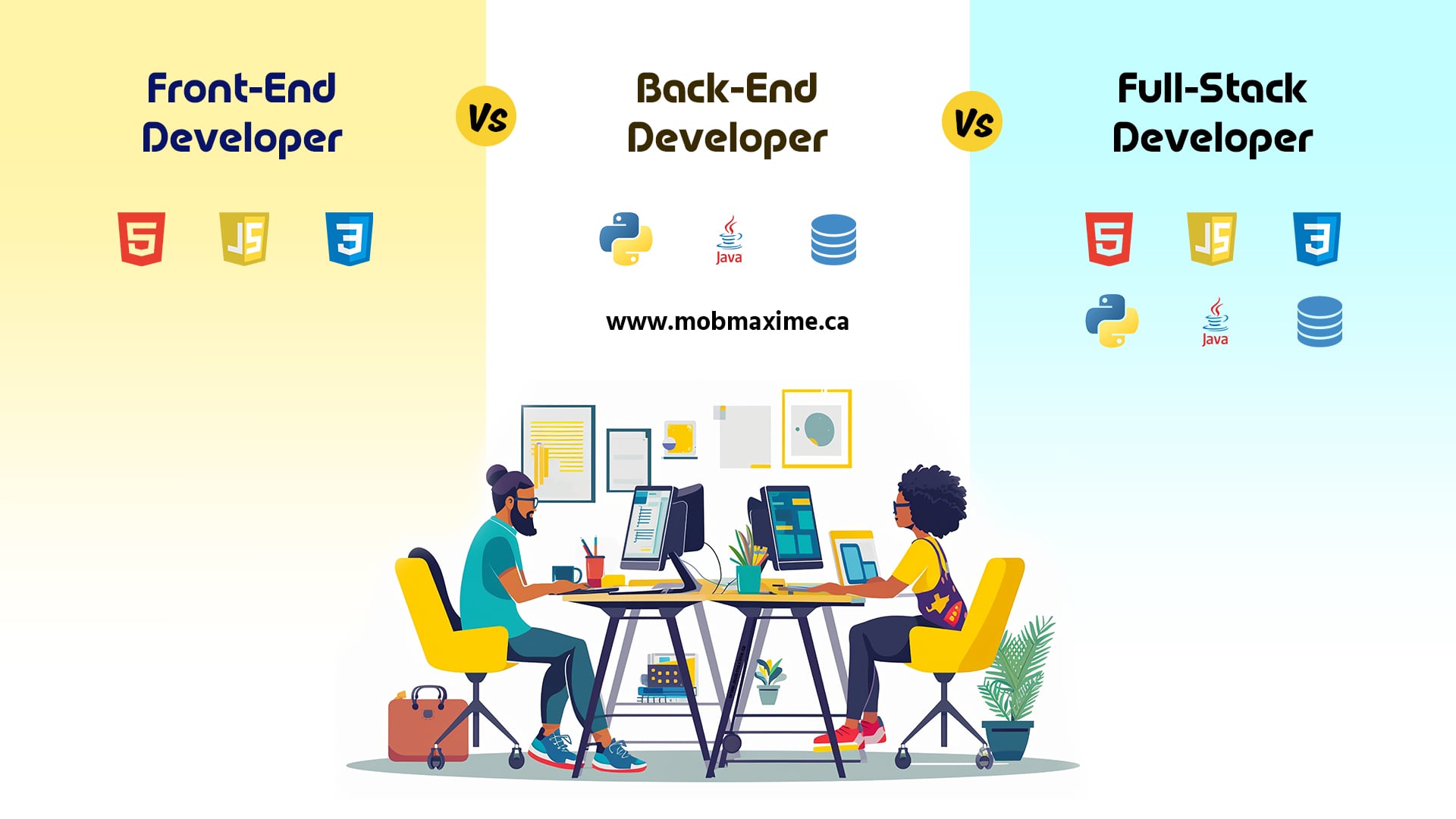
Know the Difference Between Frontend, Backend, and Full-Stack Development
- 7 Minutes. to Read
- Views
- 42
Planning to build your next web project but confused between frontend, backend, and full stack development? Let me clear up your confusion;
- Frontend development focuses on the website’s visual aspects and user experience utilizing languages like HTML, CSS, and JavaScript.
- Backend development focuses on the server side, data management, and website security utilizing PHP, Python, Ruby, Java, etc.
- Full stack development focuses collectively on the frontend and backend of a website or web application, using a mix of technologies.
A top web development company will have expertise in each domain. Still, you will need a better understanding to make an informed choice. Read on to learn what encompasses frontend, backend, and full-stack developers and the role of developers in each segment.
TL;DR
| Parameter | Frontend Development | Backend Development | Full-Stack Development |
| Focus | User interface (UI) and User Experience (UX). | Server-side logic and Overall functionality. | Both UX/UI and server-side development. |
| Skills & Technologies | HTML, CSS, JavaScript, and frameworks like React, Angular, etc. | Python, Java, and database technologies like MySQL, PostgreSQL, and APIs. | A combination of both frontend and backend skills. |
| Tools | Design Tools like Figma, Code editors like Visual Studio Code, and Browser Dev Tools. | Git – Version Control
PuTTY – server management phpMyAdmin – Database management. |
A merger of two of the relevant technologies, including frontend and backend. |
| Problem-Solving | Visual appeal, User Interaction, and Responsiveness | Data Security and Scalability plus server-side efficiency. | Creating a balance between UX and performance plus a holistic view. |
| Collaboration | Work with designers and backend developers. | Work with frontend developers, API, and Data structures. | May work independently or with developers. |
5 Points to Understand the Difference B/W Full-stack, Frontend, and Backend
Websites are important for your business. They increase your visibility, bring sales, and entertain your audiences to build long-lasting relationship. But for a website to succeed, it must be built right, following the right path and with a pinch of innovation.
Every website you see today has two parts: backend and frontend. Fullstack is the combination of these two. Let’s learn the key differences among each.
-
Focus – What Happens Here
- Frontend: Your website’s visual appeal, intuitiveness, design, etc., are part of the creation of frontend development. Focusing intensely on user experience, the frontend improves how users interact with the website.
Everything from the color palette to images, videos, fonts, interactions, animations, scrolling, etc., is frontend. The goal is to create captivating interfaces boasting the best user experience principles for enhancing engagement.
Whether the website is accessed on a narrow phone or a 55-inch display, frontend developers must build a responsive design ensuring that the UI adapts seamlessly without hindering the user’s visibility.
-
- Backend Development: Also called server-side programming, backend development must result in a smooth and flawless application. The developers create and manage the code, plus the website structure, to ensure peak performance at all times.
Backend developers use their expertise and experience to ensure smooth data storage, retrieval, and manipulation of data. They also work with Application Programming Interfaces (APIs) to integrate additional 3rd-party applications with the website to enhance functionality.
-
- Full-Stack Development: This form of development constitutes everything included in frontend and backend development. Full-stack developers work independently on frontend and backend components of the website.
The focus here is to build the complete solution from scratch, boasting a user-friendly interface and smooth server-side functionality. The developers must be adaptable and ready to wear different caps to achieve the mission.
-
Skills and Technologies
-
- Frontend Development: Frontend developers must be adept at the core languages, including;
-
-
- HTML
- CSS
- JavaScript
-
In addition to these, they must employ JavaScript frameworks for web development. These pre-written libraries offer a faster way to build complex interfaces while maintaining effective user interactivity. Some of the most popular ones are React, Angular, and Vue.Js.
These are pre-fabricated components and libraries, giving developers the luxury of focusing on the website’s functionality instead of spending too much time on UI elements.
-
- Backend Development: Backend developers must be familiar with programming languages like PHP, Python, and JavaScript. They need to build versatile backend structures, know how to set version control, and possess problem solving skills when facing complex development work.
Databases are the lifeblood of any website and a top web development company will focus on building an efficient database management system for its client’s products. Backend developers must work with MySQL or PostgreSQL to build database management systems.
Backend developers also create and manage APIs to enable the front end to send requests to the backend for receiving data, completing a function, etc. They standardize the communication channels between the client side and server side.
-
- Full-Stack Development: Since full-stack developers work on both frontend and backend, they need an in-depth understanding of technologies in both domains. The key for these developers is to adapt according to the project requirements. They may have to switch frequently between frontend and backend development work.
-
Tools Used
- Frontend Development: A mix of creative and technical tools are used by a front end development company. Technical tools are related to coding, and creative tools are related to design and similar aspects.
- Design Tools: Frontend developers work with designers using tools like Figma, Sketch, Balsamiq, etc., helping them translate their vision to functional digital assets. While the designers share the designers, developers codify them to build websites.
- Code Editors: Using Visual Studio, Sublime Text, etc. tools, the developers edit their code to ensure it is clean and efficient.
- Browser Developer Tools: Chrome DevTools and FireFox DevTools are used for debugging and testing purposes. Frontend developers use these tools to debug and test code. They also identify errors and fine-tune the codebase to deliver exceptional user experience across all browsers and devices.
- Backend Development: Behind the curtain, backend developers use a host of advanced tools, server management, and smooth data flow.
- Version Control: In a backend development company, multiple developers work on the same project. A version control system like Git will help track changes to the code, facilitating smooth collaboration.
- Server Management: Backend developers use tools like PuTTY or SSH to safeguard the connectivity between the servers where the project will run. They use these tools for maintenance tasks and fine-tuning for efficient performance.
- Database Management: For database related tasks, tools like phpMyAdmin or pgAdmin are employed. In addition to management, developers use them to write queries, create tables, and retrieve data.
- Full-Stack Development: Full-stack developers use a host of tools for respective tasks and functions. They often merge the code editors for frontend and backend development, version control, and server management. A full-stack developer’s toolbox is a fusion of all the essential tools they need to build an impressive website. Moreover, they adapt and change the toolbox according to the project requirements.
- Frontend Development: A mix of creative and technical tools are used by a front end development company. Technical tools are related to coding, and creative tools are related to design and similar aspects.
-
Problem Solving Approach
Problem-solving is a mandatory attribute for every type of development. It is required to test ideas and apply the best practices. It’s about using a logical thought process to identify and resolve problems.
-
- Frontend Development: Three core problems often trouble frontend developers;
- User Experience: The developers need to empathize with their users and analyze their struggles to find befitting solutions. They must think from the user’s perspective and create solutions that have effective clarity.
- Visual Appeal: For when websites appear cluttered, frontend developers need to solve the same and create a clean and visually appealing layout.
- Better Responsiveness: The design thinking must be such that it adapts seamlessly to the different screen sizes. Frontend developers prioritize responsive designing techniques to deliver a memorable user experience.
- Backend Development: Backend developers are the architects of the website’s logic. Hence, their problem-solving approach must emphasize data security and scalability.
- Data Security: Backend developers prioritize implementation of robust security measures to protect sensitive information. Their problem-solving approach must include streamlining data storage, access control, and encryption to prevent unauthorized access.
- Growth Scalability: They take care of the website scalability to ensure it can handle the surge in traffic. This is done through code optimization and choosing the right databases while implementing strategies for scale servers.
- Server-Side Operations Optimization: From devising strategies to maintain website speed to correcting server performance issues. They improve database queries and implement caching mechanisms for smooth server operations.
- Full-Stack Development: Full-stack developers have to balance several aspects during development and strike a balance between functionality and user experience. The problems they solve pertain to optimizing page load speed while ensuring that the backend can handle the traffic load efficiently.
- Frontend Development: Three core problems often trouble frontend developers;
Frontend and backend developers face the same issues, but separately. They might work together to resolve them; a full-stack developer needs a holistic problem-solving approach.
-
Collaboration
- Frontend Development: They can work independently but may have to collaborate with designers and backend developers. Whereas working with designers ensures visual consistency, working with backend developers ensures a smooth data flow.
- Backend Development: For backend developers, working with frontend developers is a responsibility as they need to build APIs and data structures that the frontend will utilize.
- Full Stack Development: Full-stack developers can work independently on a project or take assistance. Generally, small projects work alone, but larger ones may need help from a dedicated backend or frontend developer.
Choosing Between Fullstack, Backend, and Frontend Development
When building a website, the choice between frontend, backend, and full-stack development can be confusing. Frontend and backend are two integral parts of every website, application, software, etc., and building each segment with expertise is essential.
However, for a business, the choice between the frontend-backend combo and fullstack narrows down to availability and costs. You may find the top web development company which offers all three sorts of development services.
To choose among them, consider your project scope and complexity, plus budget. A full-stack development company is cost-efficient as compared to a dedicated backend and frontend development company. Moreover, if you need the website in a short span of time, a full-stack developer can deliver it quickly, unlike a frontend or backend development company. So, carefully evaluate all your choices to make a decision.
But I have a better solution for you.
Contact Us. Mobmaxime is a full-scale frontend, backend, and fullstack development company. We will recommend the right combination of development team and mode after considering your requirements, budget, product launch time, target audience, and a host of other factors.
Share your ideas and vision with us and we will build a tailored plan for your needs. Let’s get started.
Table of Contents
Recent Blog
-

-

-
-
How Agentic AI Is Reshaping Software Development
May 9, 2024
Category
Newsletter