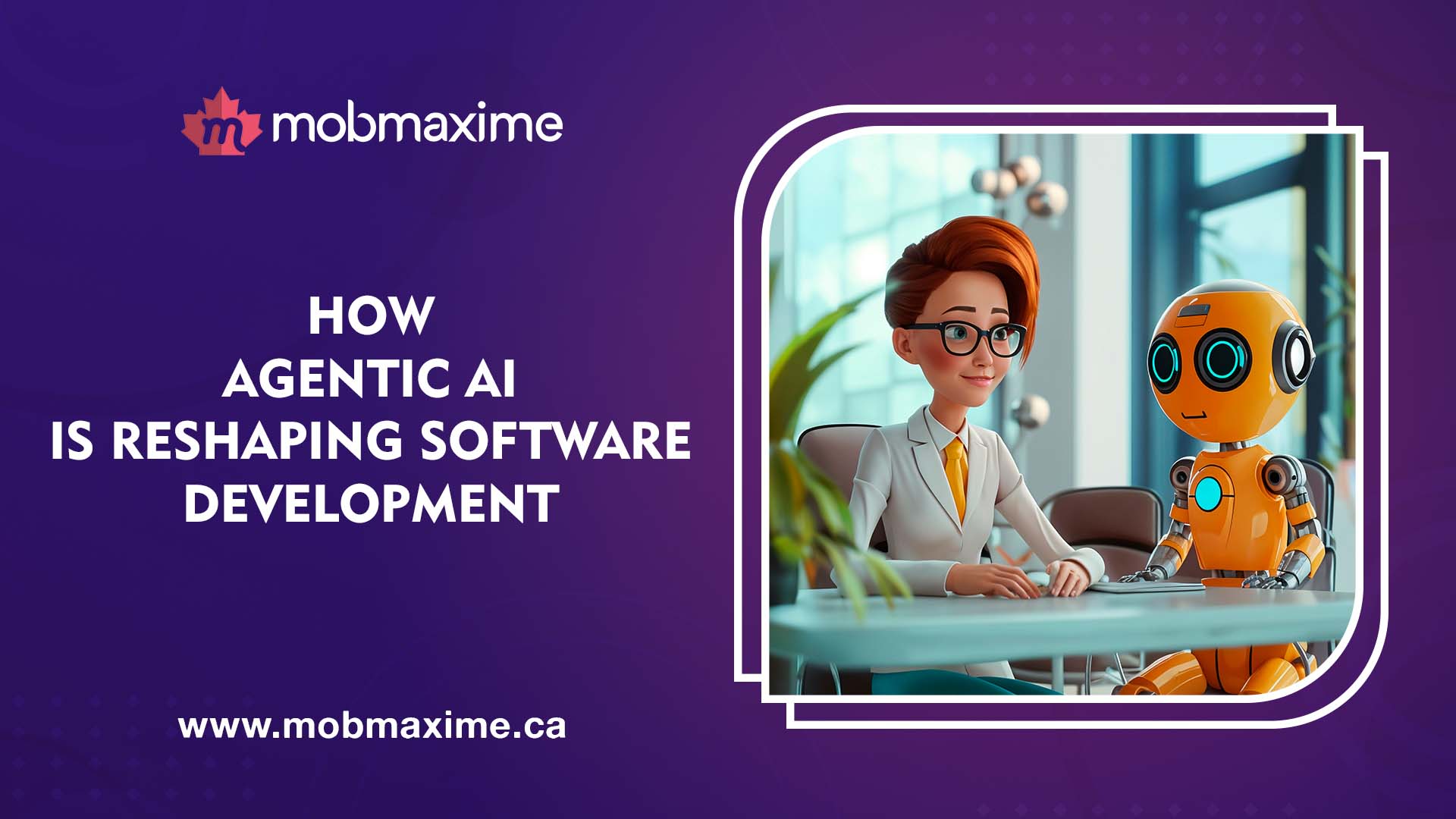
How Agentic AI Is Reshaping Software Development
- 8 Minutes. to Read
- Views
- 12
Software development is undergoing one of the most profound transformations since the rise of cloud computing and agile methodologies. While generative AI tools have already changed how developers write and understand code, a more powerful paradigm is now emerging: agentic AI in software development. Unlike traditional AI assistants that respond to prompts, agentic AI systems are designed to plan, decide, act, and learn autonomously across complex workflows.
In 2026, agentic AI software development is no longer experimental. It is actively reshaping how products are designed, built, tested, deployed, and maintained. Development teams are shifting from manual, human-driven processes to AI-orchestrated development lifecycles, where intelligent agents collaborate with humans to achieve outcomes faster, cheaper, and at higher quality.
This pillar guide explores what agentic AI is, how it works, and why it is redefining software engineering. We will examine its impact across the software development lifecycle, its differences from generative AI and LLMs, real-world use cases, business implications, and what the future holds for developers and organizations.
What is Agentic AI in Software Development?
Agentic AI refers to artificial intelligence systems that can operate as goal-oriented agents rather than passive tools. In software development, this means AI agents that can:
- Understand high-level objectives (e.g., build a feature or fix a bug)
- Break goals into tasks and subtasks
- Decide which tools, frameworks, or codebases to use
- Execute actions such as writing code, running tests, or deploying builds
- Observe outcomes and adjust behavior accordingly
Unlike single-model AI tools, agentic AI systems often consist of multiple specialized agents working together. For example, one agent may focus on requirements analysis, another on coding, another on testing, and another on DevOps. This multi-agent approach mirrors how real engineering teams operate.
At its core, agentic AI in software development introduces autonomy, reasoning, and persistence—capabilities that go far beyond simple code generation.
Must Read: Top AI Development Company in Canada
Agentic AI vs Generative AI vs LLMs
To understand why agentic AI is such a major shift, it is important to clarify how it differs from existing AI approaches.
Generative AI
Generative AI focuses on producing content such as text, code, images, or audio based on prompts. In software development, generative AI tools help developers:
- Write boilerplate code
- Generate documentation
- Explain existing code
- Suggest refactors
However, generative AI is reactive. It does not plan workflows or take initiative beyond the immediate prompt.
Large Language Models (LLMs)
LLMs are the underlying models powering many generative AI tools. While powerful at reasoning and language understanding, LLMs alone do not manage long-running tasks, memory, or decision-making across systems.
Agentic AI
Agentic AI systems use LLMs as reasoning engines but extend them with:
- Memory and context persistence
- Tool usage and API integrations
- Task planning and orchestration
- Feedback loops and self-correction
In short, agentic AI vs generative AI is the difference between a helpful assistant and an autonomous collaborator. This distinction is why agentic AI software development is seen as the next evolution of AI-driven engineering.
How Agentic AI Reshapes the Software Development Lifecycle
One of the most significant impacts of agentic AI is its ability to transform the entire agentic AI development lifecycle, from ideation to post-deployment maintenance.
1. Requirements Analysis and Planning
Agentic AI can analyze product requirements, user stories, and historical data to:
- Identify missing or conflicting requirements
- Suggest technical architectures
- Estimate effort and timelines
- Propose optimal task breakdowns
By acting as a planning agent, AI agents in SDLC reduce ambiguity and accelerate the transition from idea to execution.
2. Architecture and Design
In the design phase, agentic AI systems can:
- Recommend system architectures based on scalability and cost constraints
- Compare frameworks, languages, and cloud services
- Generate initial design documents and diagrams
This allows human architects to focus on strategic decisions rather than repetitive analysis.
3. Coding and Implementation
Agentic AI coding tools go beyond autocomplete. They can:
- Implement entire features across multiple files
- Refactor legacy codebases
- Ensure adherence to coding standards
- Coordinate changes across microservices
By maintaining awareness of the broader codebase, agentic AI programming reduces integration issues and technical debt.
4. Testing and Quality Assurance
Agentic AI for software testing introduces autonomous QA agents that:
- Generate unit, integration, and end-to-end tests
- Run tests continuously
- Identify flaky tests and root causes
- Suggest fixes or implement them automatically
This leads to higher test coverage and faster feedback cycles.
5. DevOps and Deployment
AI agents for DevOps can manage:
- CI/CD pipelines
- Infrastructure provisioning
- Rollbacks and incident response
- Performance monitoring and optimization
By treating infrastructure as an autonomous domain, agentic AI software development enables true continuous delivery.
6. Maintenance and Optimization
Post-deployment, agentic AI systems monitor applications in real time. They can detect anomalies, predict failures, and even implement self-healing code with AI, fixing issues before users are impacted.
Must Read: AI Agents vs Chatbots vs LLMs: What Your Business Really Needs
Multi-Agent Systems in Software Engineering
A defining feature of agentic AI is the use of multi-agent systems in software engineering. Instead of a single AI handling everything, responsibilities are distributed across agents with clear roles.
Common agent roles include:
- Product Manager Agent
- Architect Agent
- Coding Agent
- Testing Agent
- DevOps Agent
- Security and Compliance Agent
These agents communicate, negotiate priorities, and collaborate toward shared objectives. This structure improves scalability and reliability, especially in large enterprise environments.
Benefits of Agentic AI for Developers and Teams
The adoption of agentic AI for developers delivers measurable benefits:
- Increased Productivity: By automating repetitive and time-consuming tasks, agentic AI allows developers to focus on problem-solving, innovation, and design.
- Faster Time-to-Market: AI-driven workflows reduce delays between planning, coding, testing, and deployment.
- Higher Code Quality: Continuous testing, refactoring, and monitoring result in more stable and maintainable codebases.
- Reduced Burnout: Developers spend less time on firefighting and manual debugging, improving job satisfaction.
Agentic AI in Enterprise Software Development
Large organizations are increasingly adopting agentic AI for enterprise software development to manage complexity at scale.
Governance and Control
Modern agentic AI platforms include guardrails for:
- Security policies
- Compliance requirements
- Access controls
- Auditability
This ensures autonomy without sacrificing accountability.
Cost Optimization
Agentic AI development cost is often lower over time due to:
- Reduced manual effort
- Fewer production incidents
- Faster delivery cycles
Custom Agentic AI Development
Many enterprises choose custom agentic AI development to align agents with proprietary systems, workflows, and business rules.
Real-World Use Cases of Agentic AI in Software Development
Across industries, organizations are deploying agentic AI to solve real problems:
- SaaS companies use AI agents to continuously optimize features based on user behavior
- FinTech firms rely on agentic AI for secure, compliant development workflows
- HealthTech platforms use autonomous testing agents to meet strict regulatory standards
- Startups leverage agentic AI to build MVPs faster with smaller teams
These real-world examples of agentic AI in software development demonstrate its versatility and impact.
Will Agentic AI Replace Software Developers?
One of the most common concerns is whether agentic AI will replace human developers. The reality is more nuanced.
Agentic AI excels at execution, optimization, and automation. Humans excel at creativity, empathy, ethics, and strategic thinking. The future of software engineering lies in human–AI collaboration, where developers guide, supervise, and augment AI agents.
Rather than eliminating jobs, agentic AI reshapes roles. Developers become architects, reviewers, and orchestrators of intelligent systems.
Challenges and Risks of Agentic AI Software Development
Despite its promise, agentic AI introduces challenges:
- Security risks from autonomous actions
- Bias or errors in decision-making
- Over-reliance on AI without human oversight
- Complexity in debugging multi-agent systems
Addressing these risks requires strong governance, transparency, and human-in-the-loop controls.
The Future of Software Development with Agentic AI
Looking ahead, the future of software development with agentic AI includes:
- Fully autonomous software development for well-defined domains
- AI-orchestrated development teams
- Self-optimizing applications
- New programming paradigms focused on intent rather than implementation
As tools mature, autonomous software development will become more common, especially for internal tools and standardized applications.
Conclusion
Agentic AI is not just an incremental improvement—it is a fundamental shift in how software is built and maintained. By introducing autonomy, collaboration, and intelligence across the development lifecycle, agentic AI in software development empowers teams to move faster, build better products, and adapt to constant change.
Organizations that embrace agentic AI software development today will gain a significant competitive advantage tomorrow. For developers, the rise of agentic AI represents an opportunity to evolve, upskill, and focus on higher-value work.
The question is no longer whether agentic AI will reshape software development, but how quickly teams are ready to adapt and lead this transformation.
Ready to transform your software development workflow?
Get a free Agentic AI readiness assessment and discover where autonomous AI agents can deliver the fastest ROI in your SDLC.
Frequently Asked Questions (FAQ)
1. What is agentic AI in software development?
Agentic AI in software development refers to AI systems that act as autonomous agents capable of planning, decision-making, and executing tasks across the software development lifecycle. Unlike traditional AI tools, agentic AI can independently write code, run tests, manage deployments, and improve systems based on feedback.
2. How is agentic AI different from generative AI?
Generative AI focuses on creating content such as code or text based on prompts, while agentic AI goes a step further by autonomously planning workflows, using tools, coordinating tasks, and learning from outcomes. In short, generative AI assists developers, whereas agentic AI collaborates and acts.
3. Can agentic AI replace software developers?
Agentic AI is unlikely to fully replace software developers. Instead, it reshapes their roles by automating repetitive tasks and enabling developers to focus on architecture, problem-solving, and innovation. The future of software engineering is human–AI collaboration, not replacement.
4. How does agentic AI improve the software development lifecycle?
Agentic AI improves the SDLC by automating requirements analysis, coding, testing, deployment, and maintenance. AI agents can continuously optimize workflows, detect issues early, and even implement self-healing code, resulting in faster delivery and higher-quality software.
5. What are the benefits of using agentic AI for developers?
Key benefits include increased productivity, reduced manual effort, faster time-to-market, improved code quality, and lower burnout. Agentic AI allows developers to spend more time on strategic and creative tasks instead of repetitive development work.
6. Is agentic AI suitable for enterprise software development?
Yes, agentic AI is increasingly used in enterprise software development. With proper governance, security controls, and human oversight, enterprises use agentic AI to manage complex systems, reduce development costs, and scale engineering efforts efficiently.
7. What is the future of software development with agentic AI?
The future includes AI-orchestrated development teams, autonomous testing and deployment, self-optimizing applications, and intent-driven programming. As agentic AI matures, parts of software development will become fully autonomous, especially for standardized and repetitive use cases.
Table of Contents
Recent Blog
-
Cursor AI vs Google Antigravity: Which AI Coding Tool Wins?
January 13, 2026 -
How to Implement Machine Learning in Your Business: Step-by-Step
January 13, 2026 -
Agentic AI Coding Tools Every Developer Should Know
January 13, 2026 -
How Agentic AI Is Reshaping Software Development
January 13, 2026
Category
Newsletter