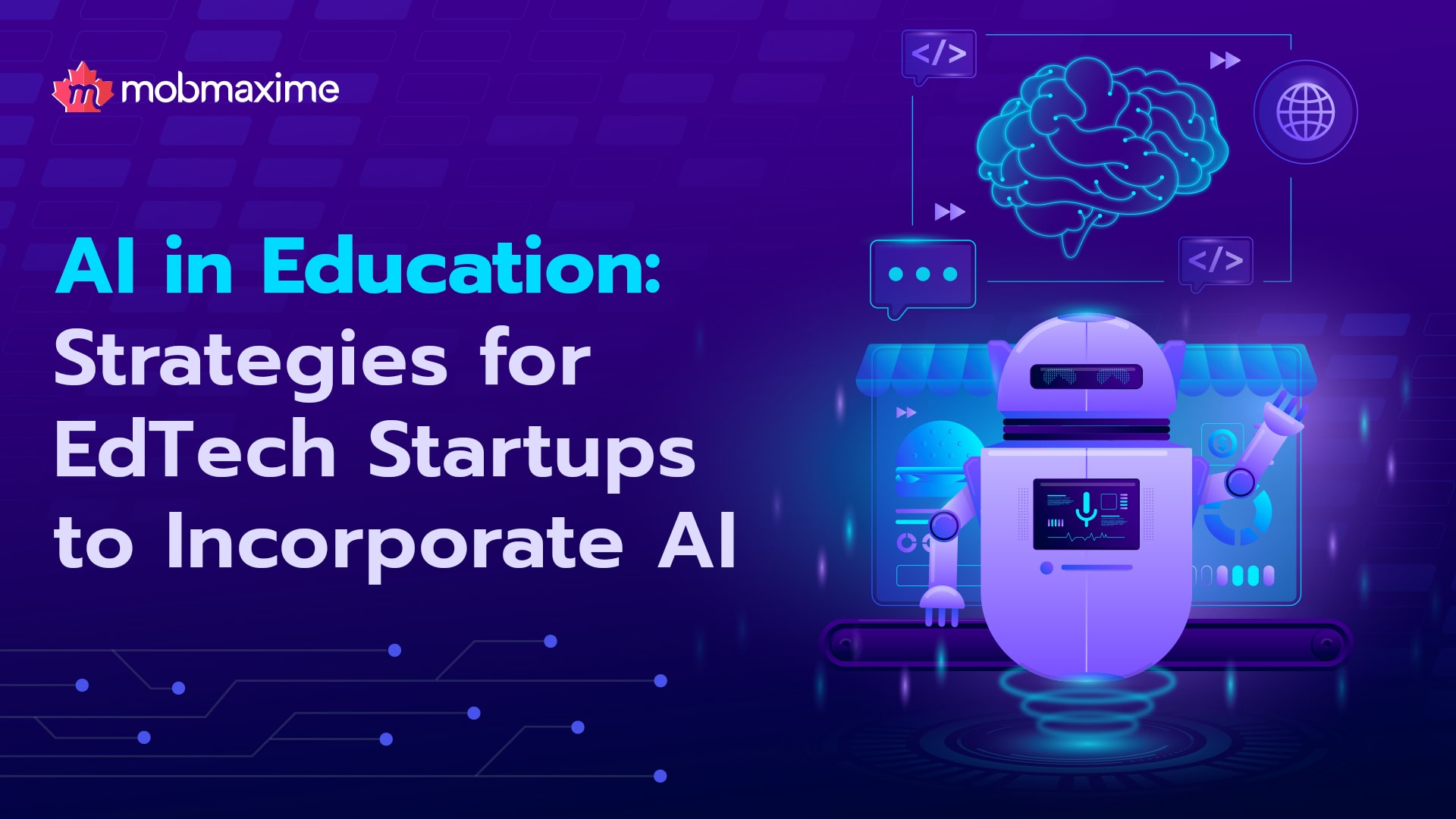
AI in Education: Strategies for EdTech Startups to Incorporate AI
- 7 Minutes. to Read
- Views
- 40
Artificial intelligence has the potential to personify what we learn through education and make it more interactive than ever. We will discuss the power of AI in Edtech today. Sit tight and prepare to be amazed by the new possibilities of this technology in education.
AI is winning every market today because of its expansive transforming potential. AI in education for EdTech startups means they can improve a student’s learning experience and help teachers bring the concepts to life.
If you are building an EdTech startup or are running one, here are a few ways to leverage AI to build and deliver a better product for your target audience.
An Overview of AI in EdTech
Artificial intelligence in the EdTech market is expected to reach $30.2 billion by 2032. According to the researches at present, this growth will be driven with two core services;
- Personalized learning
- Increasing investments in AI technology
Artificial intelligence increases the computational power of a machine, allowing it to process vast amounts of data. This data processing capability is one of the key drivers of AI’s integration into education.
A HolonIQ finds that the past couple of years have seen 15% to 25% more usage of AI in core education processes. We can only expect the scale of utilization to increase in the future.
A 2020 IDC report found a concurrence rate of 99.4% agree that AI is becoming instrumental for the future of education.
Given these numbers and future scope, a number of EdTech startups are exploring new ways to build AI-based solutions.
X Ways EdTech Startups Can Harness AI to Grow Their Business
A lot of EdTech startups across the globe have gained prominence after using artificial intelligence to improve their products and services. After carefully gauging the market, these startups found gaps to introduce new products and acquire customers.
Here are a few strategies to build AI-based EdTech products and solutions.
-
Task Automation
Artificial intelligence cannot replace teachers and the value they bring along while teaching students. But it can help lighten their workload and automate operations like;
- Creating and maintaining reports
- Making presentations
- Taking notes
- Test grading
- Record keeping
As these tasks are taken care of, the teachers can devote more time and resources towards teaching. Moreover, they can use AI to schedule meetings, track student attendance, and manage permission forms. All these tasks are going to take off a major administrative load from the teachers and give them time to focus on curating better teaching material and courses for the students.
-
Help With Course Development and Teaching Material
In an effort to build cutting-edge custom EdTech solutions, companies like yours can help teachers access generative AI-based solutions to build new course material.
Taking the help of a dedicated solution, teachers can create quizzes, notes, and other study materials to distribute and teach the kids. The generative AI solutions work as a knowledge base for the teachers.
Teachers and coaches can curate educational resources and high-impact contact with AI tools. They can build customized learning material for every type and grade of student, ensuring maximum student retention.
-
Personalized Tutoring and Assistance
Artificial intelligence in education is making personalized learning easier and more accessible. From creating customized learning materials to assessing each student according to their understanding levels and requirements, AI is making learning quick and efficient.
Intelligent Tutoring System
ITS represents a new domain of learning management systems created to deliver better personalization and efficiency in AI’s instruction design capabilities. In addition to using AI, ITS also harnesses deep learning and machine learning to provide assistance in four areas;
- Knowledge Base: It’s used for gathering information and generating study instructions or creating tests.
- Student Base: The Student base is representative of the existing student’s state of learning and progress.
- Pedagogical Module: It includes a collection of teaching and instructional approaches plus techniques and is used for training.
- User Interface: An intuitive interface facilitating a smooth and effective exchange of information between the ITS solution, students, and teachers.
Earlier, an Intelligent Tutoring System required around 200 development hours, including research, to create a tutor-friendly instructional model. However, with AI, the ITS requires only 30 minutes of human instruction to create a 30-minute lesson.
As an entrepreneur, you can leverage this aspect to invest in the future of AI in education and build accessible ITS for the end-users.
Adaptive Teaching in Classroom
A survey found that teachers are more keen to use AI in the classroom than students. More than 62% of K12 teachers agreed to use ChatGPT and related classroom solutions for various purposes.
Teachers and students cannot ignore the impact of generative AI tools like ChatGPT, Bard, etc. So, building a solution dedicated to classroom teaching with generative AI and related technologies will be beneficial for the coming years.
Adaptive teaching means teachers can quickly create personalized assessment tests and course material in the classroom. Moreover, when added with gamification elements, these AI teaching applications can further enhance a student’s learning experience.
At-Home Learning Enhancement
Another personalized learning strategic solution to implement AI in EdTech is creating a solution for the students. When students struggle to understand the concepts at home, they can use AI tools to get all the answers.
Whether they need algebra solutions or understand chemical reactions, AI can simplify complex subjects and improve grasping power. For this, you can build AI-powered chatbots and virtual learning assistants to help students improve their studies.
Empower the assistants also to provide personalized feedback to the student and provide urgent instructions.
-
Smart Content Creation
Another one of the benefits of AI in education is the ability to create smart content. Instead of using a host of visualization tools, AI can synchronize smart content creation.
Information Visualization
Instead of learning all the historical dates from a book or notes, the teachers take a student through a virtual tour of the historical places and events. Learning about past events with visualizations can make the concepts more clear and easy to grasp.
The same is applicable to concepts in physics, mathematics, geography, and all the other subjects. The students can learn with a new perspective, improving their memory and memory.
-
Predictive Analytics into Education
Teachers and parents can use AI algorithms to analyze student performance data and detect underlying patterns. Teachers can forecast a student’s performance by comparing this data with benchmark values.
This component of AI in education for EdTech startups can be harnessed to build dedicated services or applications to deliver such a service. AI-empowered quick and effective intervention means better support for the students.
As teachers and parents can address the student’s performance early on, it gives them time to recommend suggestions for improvement.
What are the Benefits of AI in Education for Students, Parents, and Teachers?
Students can get a deeper understanding of the subjects and concepts. Whether through AI-provided personalized guidance or customized study plans, instant feedback, and query resolution, AI can tailor a student’s learning experience.
Through student-centric training, AI can solve several learning problems and foster critical thinking and creativity skills in the students. Apart from academic learning, students can explore the capabilities of AI to gain additional knowledge about their subject while enjoying the learning process.
Educators, coaches, teachers, and instructors also stand to gain from artificial intelligence in education in the following ways:
- Better engagement with the students as the teachers can understand a student’s preferences, weaknesses, and strengths through AI. Using this information, they can deliver student-centric lectures and learning materials to increase engagement.
- AI will make teachers more efficient by removing the administrative load from their shoulders.
Lastly, parents can also become more aware of their child’s educational growth. The power of AI in EdTech is seen when parents can better connect with their kids regarding their educational interests, strengths, and weaknesses.
Challenges for Implementing AI in EdTech
While AI has several benefits and use cases to improve EdTech, the journey can be challenging.
- Student and Teacher Data Privacy: As an EdTech organization, you must ensure the security of student data and comply with privacy regulations. Build accountability and authentication systems within the EdTech solution to handle students’ and teachers’ data with the utmost care.
- Equitable Access to the Technology: Ensure access to AI technology for all types of students. This will not be easy, given the accessibility limitations of some students. Hence, as a startup looking to deliver AI-based solutions, strategize to bridge the digital divide and let all students benefit from this technology.
- AI Content Quality: Generative AI is a trained model that can also learn from new developments and material. Hence, the answers AI-based solutions are not infallible and are prone to mistakes. It’s essential to build quality control measures to ensure that the AI solution you build helps the users.
- Ethical Use of AI: Startups should use AI responsibly and promote the same among their target audience. With AI still under training, build solutions that avoid bias and discrimination and prevent misuse of AI-based tools.
Ready to Build your First EdTech Startup?
Building cutting-edge custom EdTech solutions requires strategic planning, a unique idea, and a team to bring your ideas to life. Building a product with in-depth market research, customer understanding, and competitor research will allow you to find the gaps.
With Mobamaxime’s expertise of integrating artificial intelligence in education, you can end up with a unique and futuristic solution. We can help you with every aspect of application development and build an intelligent solution.
Get in touch with our team to learn more about our experience and capabilities to build the required solution for your EdTech startup.
Table of Contents
Recent Blog
-
Cursor AI vs Google Antigravity: Which AI Coding Tool Wins?
February 15, 2024 -
How to Implement Machine Learning in Your Business: Step-by-Step
February 15, 2024 -
Agentic AI Coding Tools Every Developer Should Know
February 15, 2024 -
How Agentic AI Is Reshaping Software Development
February 15, 2024
Category
Newsletter